





Student lands dream opportunity after completing OCC’s short-term training program.
As an underemployed individual in the customer service sector, Breia Roberts worked a few jobs in retail and had previously taken classes at Oakland Community College (OCC). Then life happened for the young mother of two from Pontiac who was busy raising a family.
Even though she admits to losing direction a little once she had children, she was determined and ready to start something new in her professional life.
She had taken some machinery classes while in high school and still had an interest in the Computer Numerical Control (CNC) industry. After doing some research, she realized the five-week CNC Machine Operator training program at OCC was a great opportunity and decided it was time to take that next step in her career, with her ultimate goal to eventually start working at Williams International and begin an apprenticeship program**.
CNC positions are in high demand, and some of the region’s top employers include Aerotek, Ranstad, Sentech Services, Taledeco, and Williams International, according to research provided by the Workforce Intelligence Network. Many offer premium pay if the employee is on a second or third shift. CNC Machine Operators in Oakland County can anticipate earning between $18.05 and $33.32 per hour, with a median occupation wage of $24.12 per hour. Additionally, job growth shows stability, with a consistent number of workers in the occupation throughout the past decade, indicating steady growth. There is growth potential as individuals gain experience. Operators with experience can move into positions like Setup Machinist, CNC Tool Programmer, and more. CNC Tool Programmers, on average, can earn up to $21,700 more per year compared to their counterparts working as CNC Machine Operators.
During the application process, Roberts worked with Ebony Robinson, a case manager at the Oakland County Michigan Works! Pontiac office*. Robinson stated, “During the intake process, we talked about the CNC classes she took previously and that she had to step out at one point.” She said that Breia had the self-awareness that she needed to pause on the career path. The pandemic helped her grow and think more about what she needed.
Roberts enrolled in the CNC program in April 2023. The OCC training covers basic machining topics that can help individuals land an entry-level machinist position quickly after completion of the program.
“The instructor was very knowledgeable. The class was very hands-on and he gave us context on what has changed in the field of machining.” Roberts said.
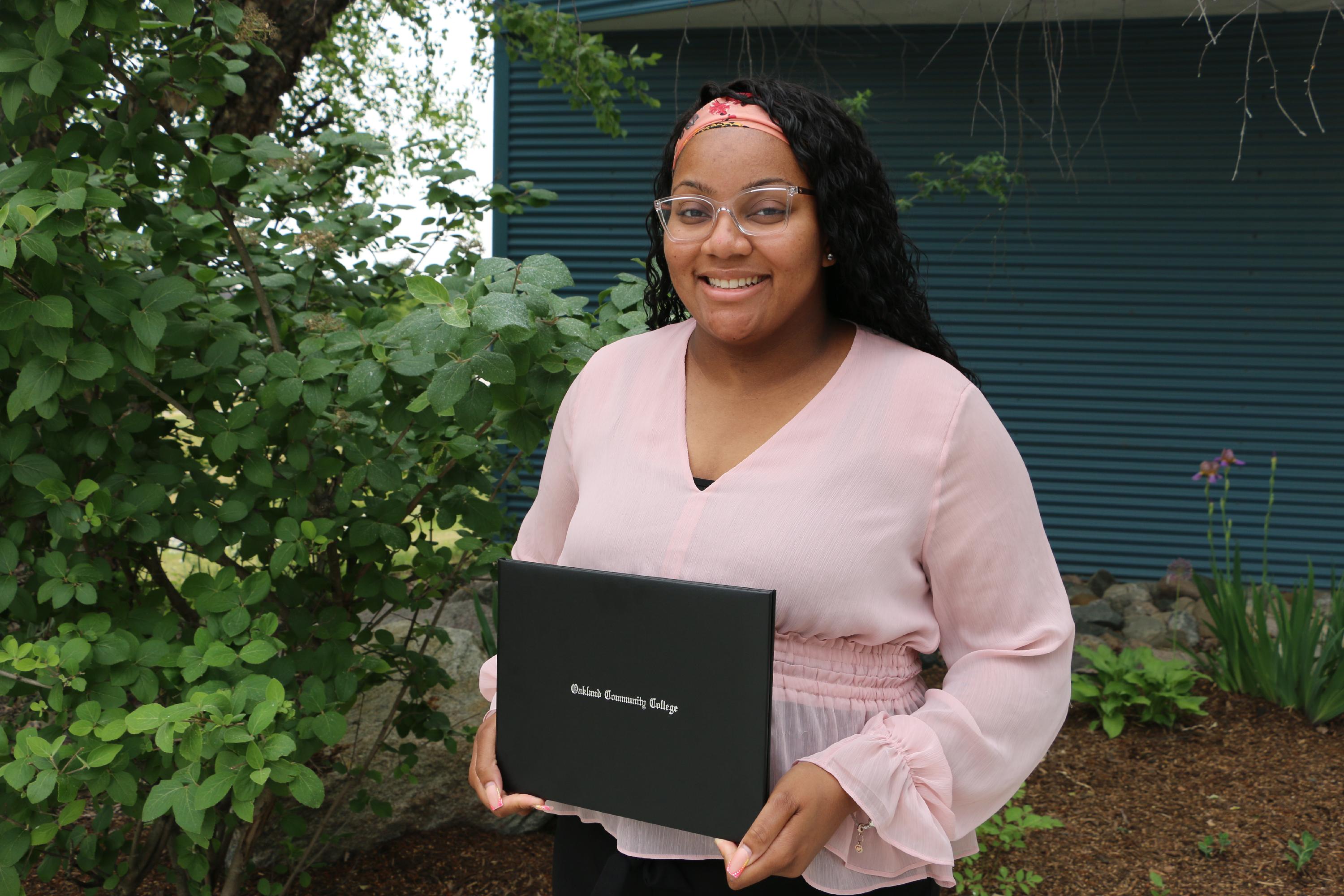
She participated in multiple CNC courses during the training, including measurement, materials and safety, job planning, milling, and turning. During the five weeks, she had hands-on experience in a CNC lab and earned five industry-recognized certifications. A bonus, after earning all of the National Institute for Metalworking Skills (NIMS) certifications, she now has the opportunity to earn course credits at OCC, which can be used towards a certificate or associate degree.
Besides the instruction and lab time, Roberts also worked with college staff and instructors to help her enhance the skills needed to effectively and successfully find a job. A professional career coach helped polish up her resume in the classroom. The program coordinator also helped her prepare for interviews. These additional resources are intended to give students soft skills and guide them toward gaining employment. Roberts had an opportunity to tour four companies and have interviews with three employers at the end of the training program.
“This program can help people take the next steps they need for a career in this field,” Roberts explained.
A little over a month after completing the training program, Roberts was hired with Williams International as a Deburr Tech. She felt that the OCC five-week training program gave her the tools and resources to help her land her dream job.
“Do it and go for it! It doesn’t matter what spot in life you’re in,“ said Roberts. ”Even if you have kids, went to college, or didn’t finish, take the opportunity while it is there.”
Eight months after completing the program, Roberts continues to thrive on the job at Williams International. Soon she’ll be visiting different areas of the plant and will be trained by mentors to get a more well-rounded perspective of the facility. Roberts feels that the short-term training program has helped her prepare for her position and succeed on the job. One specific area that the training has prepared for her job was the OSHA 10 safety training, which she says she uses daily in her job.
She has also achieved another goal by enrolling in OCC’s apprenticeship program in September 2023 and is taking additional classes during the winter 2024 semester. Roberts credits the OCC team for helping her land this opportunity.
“I really want to thank OCC for having programs like this. Working at Williams is a never-ending learning experience and I can honestly say I love my job!”
Interested in learning more about CNC careers in Oakland County? The next CNC Machine Operator training program starts April 2024. Contact Program Coordinator, Jessica Knapik at (248) 232-4527 or jaknapik@oaklandcc.edu.
If you live outside of Oakland County but want to start your CNC career, visit your Michigan Works! Agency to get started today or learn more about eligible funding opportunities by clicking here.
*Participants of OCC’s CNC Machine Operator training program, as well as many other short-term workforce programs in advanced manufacturing, information technology and transportation, may be eligible for debt-free tuition assistance and supportive services. Michigan Works! Agencies support participants to apply for funding through the One Workforce Award from the U.S. Department of Labor through a program called “Building an Industry Infinity Supply Chain”.
**Registered apprenticeship is a combination of working and learning. Apprentices are full-time employees and attend related classes on a schedule set by the employer. As an apprentice, you can learn from knowledgeable professionals who work in your field every day.
About WIN:
The Workforce Intelligence Network for Southeast Michigan (WIN) is a division of SEMCA and a collaborative effort between ten community colleges and seven Michigan Works! Agencies. In partnership with numerous other organizations, WIN is working to create a comprehensive and cohesive workforce development system in Michigan providing employers with the talent they need for success. WIN covers a 19-county area, including Eaton, Genesee, Hillsdale, Huron, Ingham, Jackson, Lapeer, Lenawee, Livingston, Macomb, Monroe, Oakland, Sanilac, Shiawassee, St. Clair, Tuscola, Washtenaw, and Wayne. WIN was founded with the support of the New Economy Initiative, has been recognized as one of the top workforce collaboratives in the nation by the U.S. Department of Labor, and celebrated 10 years of research, engagements, and solutions in August of 2021. For additional information about WIN visit winintelligence.org/about-us/.
About One Workforce Industry Infinity:
Building an Industry Infinity Supply Chain is a One Workforce grant funded by the Department of Labor (DOL), Employment and Training Administration (ETA). The purpose of this funding opportunity is to encourage applicants (WIN Board of Directors) to develop replicable, comprehensive workforce strategies for preparing the workforce for middle-to high-skilled H-1B occupations within key sectors, such as Information Technology (IT), advanced manufacturing, and transportation that are being transformed by technological advancements and automation. Grant funds have been allocated to provide curriculum development funds to WIN Community College Partners to update and create educational programs to upskill job seekers and professionals in the greater southeast Michigan region in related occupations within the industry through January 2025.
Learn more about the author Jessica Knapik by clicking here.
This workforce product was funded by a grant awarded by the U.S. Department of Labor (DOL)’s Employment and Training Administration (ETA). The product was created by the recipient and does not necessarily reflect the official position of DOL/ETA. DOL/ETA makes no guarantees, warranties, or assurances of any kind, express or implied, with respect to such information, including any information on linked sites and including, but not limited to, accuracy of the information or its completeness, timeliness, usefulness, adequacy, continued availability, or ownership. This product is copyrighted by the institution that created it.
 Twitter